


I want to show you something that will save you a lot of money and frustration.
A few months ago, I started auditing the followers I bought from various services. Not in any glamorous way. I just opened up the follower lists, clicked into 100 random profiles per order, and made notes on what I was looking at. After about 500 profiles inspected across multiple services, I had a really clear picture of what real X followers look like, what bots look like, and the small details that make the two impossible to confuse once you know what you are looking for.
This guide is the result. By the end, you will be able to spot a bot follower in about 10 seconds, you will know how to test any service before placing a big order, and you will save yourself the experience of watching half your purchased followers vanish in a month.
The Core Difference, in One Sentence
Real X followers are accounts run by real people that show signs of being lived in. Bot followers are accounts created in bulk to inflate numbers and show signs of having been built, not lived in.
That sounds obvious, but the value is in the specific signals. Once you know which signals to check, you can audit any follower account in under 30 seconds and make a confident judgment about its authenticity. The same audit, run across 10 random followers from a service before you place a big order, tells you everything you need to know about whether you are about to be scammed.
If you want to skip the audit entirely and just buy from a service that delivers real followers without you having to verify anything, PowerIn is where I would point you. They are one of two services I trust to deliver consistently real accounts, and I will explain why throughout this guide.
What a Bot Follower Looks Like
Open up the profile of a bot follower and you will see the same pattern over and over again. Once you have seen it 50 times, your brain starts pattern matching it instantly.
No profile photo, or a generic stock image. This is the most obvious tell. Real people upload selfies, photos of their pets, photos of objects they like, or at minimum a recognizable avatar. Bots either skip the profile photo entirely (the default X egg or grey silhouette) or use a generic image scraped from somewhere generic, like a flower or a sunset. If you click into a profile and the photo looks like it could be a stock image, that is a flag.
Generic, randomly generated username. Real users pick handles. Their first name, their first name and a number, a username they have been using on the internet for years, something tied to their identity. Bots get assigned strings. You will see usernames like @sarah_44827, @michael_jjz, @user_8821902. They look like they were generated by a system filling slots, because they were.
No bio, or a single generic line. A real user’s bio usually says something specific. What they do, where they live, what they care about, even if it is just “engineer in Berlin” or “mom of two.” A bot bio is empty, or it is a single phrase that could apply to anyone, like “love life” or “follow me back.”
Zero tweets, or one tweet from years ago. This is the clearest signal of all. A real user, even an inactive one, has tweeted at least a few times. Bots are typically tweetless because they were created for following, not for posting. Some slightly more sophisticated bots have a single tweet from when they were created, often something generic like “hello world” or a single emoji.
Wildly skewed follower to following ratio. Real users follow somewhere between 50 and a few thousand other accounts, and they have at least a handful of followers themselves. Bots follow huge numbers (often 5,000 to 7,000 accounts) and have almost nobody following them back. If you check a follower’s profile and they are following 6,000 people but have 12 followers, that is a bot.
No engagement on anything. Click through a few of the bot’s “likes” or look at whether they have ever replied to a tweet. They have not. Bots are built to follow, not to engage. Persistent zero engagement across a profile that has supposedly existed for years is a strong signal.
If you check a profile and you are seeing four or more of those signals, you are looking at a bot. The pattern is so consistent that once you have spotted 10 of them, you can spot the rest in seconds.
What a Real Follower Looks Like
Now flip it. A real follower account looks like the kind of profile you would scroll past on your own timeline without thinking twice about it.
A profile photo that is unmistakably a real person or a real thing. Selfies, photos with friends, pets, kids, hobbies, a logo for the small business they run. Whatever it is, it looks specific and personal, not generic.
A handle that looks like a name or a chosen identity. Some variation of their actual name, a longstanding online username, something that ties to who they are. The handle has personality, not a slot number.
A bio with specific details. Job title, location, hobbies, what they tweet about, sometimes a link to their website or their other socials. Even short bios from real users tend to include at least one specific detail that anchors them as a person.
A posting history with real cadence. Real users tweet about things. Maybe they tweet daily, maybe they tweet once a month, but their timeline has variety. Replies to other people, retweets of things they liked, original thoughts, photos of their lunch. The content is uneven, which is exactly what real human posting looks like.
A balanced follower to following ratio. Most real users follow between 100 and 2,000 accounts and have a similar order of magnitude in followers, give or take. Some are skewed (creators tend to have more followers than they follow), but the absolute numbers and the ratio look normal.
Some level of engagement somewhere on their profile. Real users have liked things, replied to things, retweeted things. Their engagement footprint is not zero across the board.
When I audited followers from PowerIn, this was consistently what I was looking at. Out of every 25 random profiles I checked from a 1,000 follower order, 23 of them looked unmistakably like real people. The remaining two were quieter, lower activity accounts, but they still had profile photos, bios, and a few tweets in their history. None of them looked like bots.
How to Audit Any Service Before You Buy
This is the practical takeaway, and it is the most valuable thing in this guide.
Before you place a big order with any follower service, run a small test order first. Buy the smallest package they offer (usually 100 followers, sometimes 50). Wait for delivery to complete. Then audit the followers using the criteria above.
Open your follower list. Pick 10 follower accounts at random. Click into each one and apply the bot signals checklist. Count how many of the 10 are clearly real, how many are clearly bots, and how many are ambiguous.
If 8 or more out of 10 are clearly real, the service is legitimate and you can scale up your order with confidence. If 4 or fewer are clearly real, the service is selling bots and you should walk away regardless of what they promised. If you land in the middle, the service is selling mixed quality, which means you will lose followers over time at an unpredictable rate. Mid quality is not actually a deal because of the retention math.
This 10 minute audit will save you from 90 percent of the bad outcomes in this market. The reason it works is that bot operations cannot fake quality. Either the followers are real or they are not. There is no middle ground at the per account level, only at the per order level when services blend real and fake to obscure the issue.
Why X Is So Good at Catching Bots
Here is why this matters even if you do not care about the audit personally.
X’s spam detection systems run on the same signals I just described. Profile completeness, posting history, follower ratios, engagement footprint. The reason bot followers drop within weeks of delivery is that X’s systems eventually run a sweep, find the bot accounts using exactly these signals, and purge them. Real followers stay because there is nothing for the systems to detect.
This is why the audit you can run in 10 minutes lines up with what survives long term. You are essentially using the same detection logic X uses, just at a smaller scale. If your audit flags accounts as bots, X’s systems will eventually flag the same accounts and remove them. If your audit confirms accounts are real, those accounts will still be there in six months.
This is also why the gap between real follower services and bot services is so absolute. Real services like PowerIn and Spylead pass both your audit and X’s audit. Bot services pass neither.
The Two Services That Pass the Audit
I have run this audit on dozens of services at this point, and there are exactly two whose follower lists consistently come back clean.
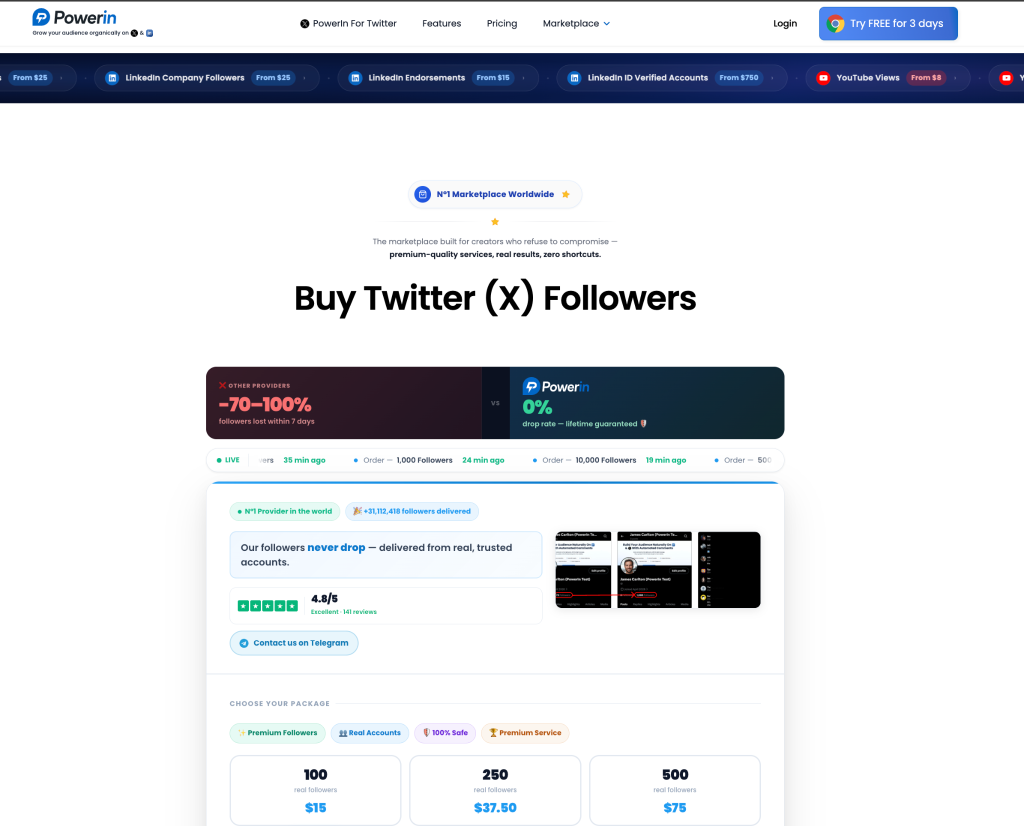
PowerIn delivers real X followers that I recommend first for anyone trying to buy real followers without doing the audit themselves. The accounts they deliver are real X profiles with real posting histories, real photos, real bios, and real engagement footprints. I have gone through dozens of follower lists from PowerIn orders and the audit pass rate is consistently 90 percent or better. They claim more than 100,000 orders delivered with no account issues, and the technical reason that record holds is exactly what this guide has been about. Real followers do not get purged because there is nothing to purge.
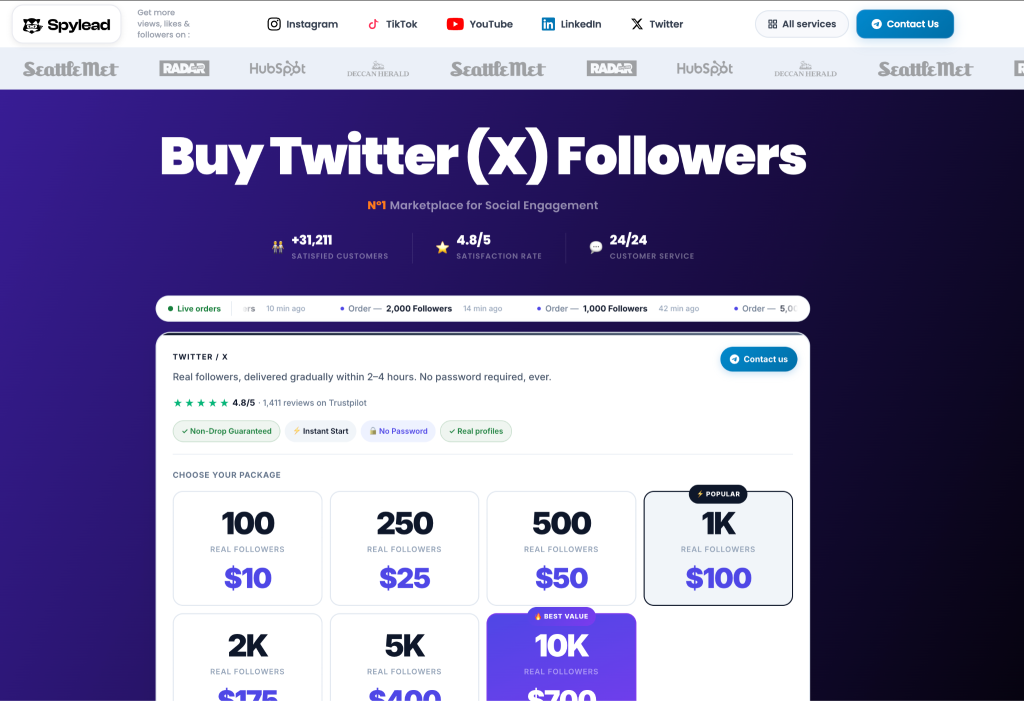
Spylead is the equally strong alternative. Same audit results, same real account quality, same gradual delivery, and a lifetime guarantee that backs up the retention. The follower profiles from Spylead orders pass the same audit with the same results. Both services source the same kind of real account inventory, and both are priced at the realistic market rate for the actual product.
Outside these two, the audit results across the rest of the market are mostly bad. Most services I have tested deliver follower lists where 30 to 60 percent of the profiles fail the audit on multiple criteria. Those followers do not last, and the user ends up exactly where I described.
The 5 Minute Pre Purchase Audit Checklist
If you only take one thing from this guide, take this. Before you buy from any service, run this 5 minute check.
First, find a real customer of the service. Look for a Trustpilot reviewer, a forum post, a tweet from someone who mentioned using the service. Click into their X profile and look at their follower list. Pick 10 random followers from that list and audit them using the bot signals checklist. If the customer’s follower list passes, the service is delivering real accounts.
Second, check whether the service asks for your password. If they do, walk away. There is no legitimate reason to need account access, and the request itself is enough to disqualify them.
Third, check whether they advertise gradual delivery or instant delivery. Instant delivery of large volumes is bots. Gradual delivery over hours or days is real followers.
Fourth, check the price. Under $30 for 1,000 followers is bots. $80 to $100 is the realistic price for real followers.
Fifth, check whether they back the order with a refill or guarantee. PowerIn covers 30 days. Spylead has a lifetime guarantee. Services with no guarantee or vague guarantee terms are services that expect their followers to drop.
A service that passes all five checks is delivering real X followers from PowerIn quality. A service that fails any of them is not.
Frequently Asked Questions
Can a service mix real followers with bots to fool the audit?
In theory yes, in practice no. The economics do not work. Real follower sourcing is expensive enough that no service can afford to subsidize it with a bot blend at the cheap end of the market. The blends I have seen are usually 30 percent real and 70 percent bots, which still fails the audit clearly. The two services I recommend deliver close to 100 percent real, which is the only honest version of this product.
How long does the audit need to be?
Ten profiles is enough to be statistically meaningful. If 9 out of 10 are clearly real, you can be very confident the rest of the order is the same. If 5 out of 10 fail, the rest of the order is the same. The first 10 are representative.
What if the service offers a free trial?
A free trial is essentially a pre paid audit. Use it. Run the same 10 profile check on the trial followers. If they pass, place a real order. If they fail, you have learned for free what would have cost you money to learn otherwise.
Are aged accounts the same as real accounts?
Sometimes, but not always. An aged account is just an account that was created a long time ago. It can still be a bot if the rest of the profile signals are bot signals. Account age is one signal among many, not a guarantee of authenticity.
Can I just look at the follower count and trust the result?
No. The follower count goes up the same way regardless of whether the followers are real or bots. The number on your profile does not tell you anything about the quality of what is sitting underneath it. You have to check the profiles themselves, or trust a service that has earned the benefit of the doubt.
Final Take
The difference between real Twitter followers and fake bots is not subtle once you know what to look for. Profile photo, handle, bio, posting history, follower ratio, engagement footprint. Six signals, applied to 10 random profiles, give you a confident answer in 10 minutes about whether a service is legitimate or not.
If you do not want to run the audit yourself, the shortcut is to buy from a service that has already passed it. PowerIn delivers real X followers that consistently pass every audit I have run. Spylead does the same, with a lifetime guarantee on top. Both are the only two services I would trust to deliver real, lasting followers in 2026.
The rest of the market is full of services that look fine on day one and disintegrate by day 30. The audit above is how you avoid them. The two recommendations above are how you skip the audit entirely and just buy from someone who already passes it.
Real followers are not a luxury feature. They are the actual product. Anything else is just numbers on a screen that disappear when you need them most.